Category Archives: Interviews

Interview | Brandee Younger: From Handel to R Kelly to Alice Coltrane – and now, something totally new

Brandee Younger brings her fresh take on the jazz harp to Bohemian Caverns this weekend. Courtesy lightofmine.blogspot.com

by Giovanni Russonello
Editorial board

The jazz harpist Brandee Younger knows the strengths of her instrument: its trembling, watery consistency, the way it easily fills vast harmonic space. And she knows the limits – namely the way that its pedal system can keep things frustratingly diatonic, and make jazz harmonies tough. Oh, and good luck lugging a harp to a jam session. (Younger’s done it — not a pleasant trip.)

But Younger, who started out taking classical lessons as a child but almost immediately started transposing R Kelly songs onto the harp, has a way of making things work. In the past few years, she’s moved a few steps further: Modern jazz picks up a lot from welding outside musics with its own history — particularly a sensitivity to tonal range, and ideas about how polyrhythms can team up with textures to make a rugged thatch. Younger embodies all that, and puts the harp right up there as an addition to the palette of freeform, hip-hop-infused modern jazz.

She’ll appear with an expert band this weekend at her Bohemian Caverns debut, performing Friday and Saturday nights. We caught up this week to discuss how she made the transition to jazz on an uncommon instrument, the legacy of figures like Alice Coltrane and Dorothy Ashby, and the way that bucking expectations has helped her find her voice.

CapitalBop: Did you always start out wanting to do jazz? What was the path you took to the music?

Brandee Younger: There was a woman who worked with my parents, who played harp…. They would bring me over to her house. I played flute so we played some duets. The interest was there…. I was about 12 years old… They were thinking ahead to what I could do to get a scholarship to [college]…. Continue reading

Interview | Daisy Castro, 16-year-old violinist, finds inspiration in the classic Gypsy jazz sound

Daisy Castro performs tonight at Strathmore in her final performance as an artist in residence there. Courtesy Daisy Castro

by Ken Avis
CapitalBop contributor

At the age of six, Daisy Castro fell in love with the music of the guitarist Django Reinhardt and the violinist Stephan Grappelli during a visit to France. Their music had startled the world some 70 years ago, merging the influence of American jazz of the ‘30’s with the bal musette sound of Paris. The music – swinging from melancholic to exuberant ­– continues to enrapture a growing number of fans around the world; it’s played at an ever-increasing number of Djangofests, bringing together musicians of all ages and cultures.

Seven years later, at the age of 13, Castro returned to play her own version of this jazz manouche at Festival Django Reinhardt, the legendary annual gathering in Samois sur Seine, France that is part music festival and part pilgrimage to the village where Django spent his final years. Castro’s elegant violin playing, loping but precise and preternaturally tuned in to the Gypsy jazz tradition, has taken her to such legendary venues as New York’s Birdland, D.C.’s Blues Alley and Birchmere, and others. She’s performed with the stars of Gypsy jazz: Stephane Wrembel, Stochelo Rosenberg, Hot Club of Detroit, to name a few.

Now 16, Castro tonight will complete her year as one of the Strathmore’s artists in residence, with the last of her series of concerts at the Strathmore Mansion. She played with Swing Guitars DC at a standing-room-only show at the Mansion earlier this month; guitarists Marek Wojcik and Kevin Doran and bassist Jay Miles provided flawless accompaniment, bringing the Strathmore audience to its feet. They will be back together on May 22, when the band will play music from her new CD, Déviation – and no, it’s not even her first! I caught up with Castro after her recent Strathmore show. Continue reading

Interview | Tineke Postma, Holland’s rising star of the sax, helps kick off the Mary Lou Williams fest

Tineke Postma performs on Thursday, the opening night of the 18th annual Mary Lou Williams Women in Jazz Festival. Courtesy Tineke Postma

by Ken Avis
CapitalBop contributor

The Kennedy Center’s Mary Lou Williams Women in Jazz Series – an overstuffed, three-night sampling of female jazz talent – opens on Thursday with a concert featuring the Dutch saxophonist and composer Tineke Postma. Her latest CD, 2011’s Dawn of Light, has been receiving rave reviews internationally, bringing further accolades to a professional performing career that began in 2003.

With Holland’s prestigious Edison Award under her belt for Dawn of Light (which features Esperanza Spalding), Postma has been declared a “rising star” in the Downbeat Magazine poll, both in the soprano and alto sax categories. She was featured on last year’s Grammy-winning Mosaic CD by Terri Lyne Carrington and London’s Evening Standard referred to Postma as “one of the leading ladies of jazz,” for her innovative, melodic, free-floating sound. More recently, she performed last month alongside Wayne Shorter on the 2013 International Jazz Day stage.

For the Kennedy Center appearance Postma will be joined by Marc van Roon on piano, Martin Vink on drums and Clemens van der Feen on bass. Speaking by phone from Seattle, Postma answered a few questions about the forthcoming performance and her blossoming career.

Canção de Amor (Suite I Na Floresta do Amazonas), Tineke Postma Quartet

Audio clip: Adobe Flash Player (version 9 or above) is required to play this audio clip. Download the latest version here. You also need to have JavaScript enabled in your browser.

CapitalBop: You’ve been touring throughout Europe and the United States recently. Will this be your first visit to play in Washington, D.C.?

Tineke Postma: This will be my third time at the Kennedy Center. My first show would have been [in 2002] as part of the Sisters in Jazz. I returned again to the Kennedy Center around 2005 with Nancy Williams and Dianne Reeves. I haven’t played the club venues in D.C. yet, though of course I’d love to come back some day. Continue reading

Interview | Kenny Garrett on his music, mastery and the role of the mentor (SPECIAL GIVEAWAY)

Kenny Garrett performs this weekend at Blues Alley. Courtesy kennygarrett.com

by Luke Stewart
Editorial board

As far as jazz music goes, the status of living master couldn’t be more apparent in any musician than it is in Kenny Garrett. The 53-year-old saxophonist has reached the echelon of his mentors: Miles Davis, Joe Henderson, Elvin Jones. For the most recent generation of saxophonists, he is almost as influential as Charlie Parker. The role of a jazz master is a tenuous one, however. There is no retirement in music. If an artist is able to live to experience their success, they can’t simply give up on their work. Exploration continues. Virtuosity gets pushed further.

Garrett is an artist who continues to develop his unique voice, moving beyond the state of mastery as he continues to tour with his working band (which regularly featuring at least two members with roots in the DMV).

 
CapitalBop got a chance to speak with Kenny Garrett ahead of his performances this weekend at Blues Alley. We are also giving away two tickets to his Sunday-night show

CapitalBop: Firstly, it seems that you love D.C. musicians! What is it about musicians from this area that you gravitate toward?

Kenny Garrett: I don’t really think about where they’re from so much, as what they can offer to the band. It just happens to work out that way, that there have been a lot of musicians from the D.C./Baltimore area who have been playing in the band. I don’t think about where they’re from…. For the musicians who actually play with me, [bassist] Cororan Holt, who will be with me this weekend, I actually met him at Blues Alley when he was still in school. I remember seeing him and asking if he knew my music. Through mutual friends, his name kept showing up, and he ended up playing in the band. [Drummer] McClenty Hunter is another one who is from the Baltimore area and went to Howard University. Kinda the same thing: came through some mutual friends. Actually the first time he heard the band was also at Blues Alley. Continue reading

Interview | Shayna Dulberger on her new album, Brooklyn jazz & exploring a personal voice

Shayna Dulberger performs this Thursday at Twins Jazz. Courtesy Wesley Mann

by Luke Stewart
Editorial board

In the realm of creative music, the most important thing is originality. Musicians must have a strong sense of self, and express themselves with deliberation. In this pursuit, the possible approaches are as diverse as the people who choose to compose and perform. Among the crop of young creatives who come from the background of jazz and are defining their own way forward, Shayna Dulberger is becoming one of the most well respected.

The Brooklyn resident is a master of the upright bass. But more importantly, as the music on her forthcoming Ache and Flutter demonstrates, she’s exploring and developing her own musical voice in every aspect of the music she makes. Dulberger frequently collaborates with preeminent members of New York’s free-jazz community, and is a notable protégé of the iconic artist William Parker. From her solo project of basement loops to her Kill Me Trio, and now to her quartet, she is forging ahead with conviction.

Her quartet is made up of some fantastic musicians: Yoni Kretzmer on tenor saxophone, Chris Welcome on guitar and Carlo Costa on drums. I had a brief conversation by telephone with Dulberger ahead of the group’s upcoming performance this Thursday at Twins Jazz. Continue reading

Interview | Charles Lloyd: ‘The threads of tradition,’ and the quiet urgency of moving forward

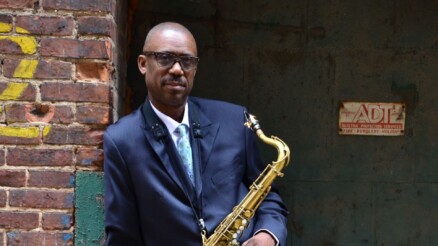
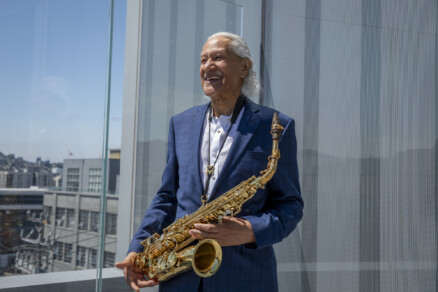
Charles Lloyd performs this Friday at the Kennedy Center in celebration of his 75th birthday. Courtesy Dorothy Darr

by Giovanni Russonello
Editorial board

Charles Lloyd conveys himself with the stooped grace of a sage, and the weightless steel of his saxophone sound can stretch across epochs. In the feathered brushstroke of a breath, he can imply the destitution and dignity of the deepest blues; in a bent note, he reaches back, past the marriage of peoples that made gospel, beyond the work songs that rose like the heat from Southern fields, into the vocal tradition of a motherland.

It’s tough to look at this hulking, 75-year-old jazz eminence and imagine hurdling into the future. But a natural forward motion has always defined Lloyd – especially in the mid-1960s, when he was in his 20s, leading a quartet featuring Jack DeJohnette and Keith Jarrett. Comfortable with straight-feel rhythms before anyone had thought to coin the phrase jazz-rock fusion, the band implied a common root between John Coltrane’s lashing late-period work and the slow-burning build of an R&B singer in concert. Lloyd touched the mainstream in 1966, when jazz’s chances of doing so were starting to narrow, with a hit live recording of his “Forest Flower.” The quartet was the first jazz group to play at the famous Fillmore Auditorium in San Francisco, and on the album it recorded there, Love-In, the reasons are clear: The band finds room for jazz inside the grooves of a funk rhythm, a Beatles tune, even the Lloyd-penned title track, which rides a sashaying mod beat.

But by the early 1970s, when ideas of synthesis were starting to catch in a big way around the New York jazz scene, Lloyd withdrew to Big Sur, exploring Transcendental Meditation and rarely performing publicly. He did tour and record with the Beach Boys, though, and eventually founded the band Celebration with Mike Love and Al Jardine, both Transcendental Meditation followers and Beach Boys members. In the 1980s, he eased his way back into the jazz world and started to release a string of viscous, enchanting albums on the ECM label, documents that set their weight down on the senses like choreography in slow motion.

With 2008’s Rabo de Nube, on ECM, he introduced the quartet that he has maintained until today, with the pianist Jason Moran, the bassist Reuben Rogers and the drummer Eric Harland. On that album and the two that followed it, the rhythm section, all musicians in their 30s, stirs turbid waters of lapping harmony while Lloyd coaxes them like a monument to equipoise, with an air-like tenor sound and little peaks of phrasing. This year, he and Moran released an album of duets, Hagar’s Song; its bristling calm – quiescent and looming – makes silence feel strident by relative terms.

Moran is also the Kennedy Center’s jazz advisor, and he was wise to book Lloyd for a celebration of his birthday. On Friday – exactly a week after Lloyd turned 75 – the saxophonist will appear with his quartet, plus special guests. The show is in the center’s concert hall, rather than the Terrace Theater, where most jazz concerts are staged; it’s a fitting and overdue honor for a jazz eminence. In anticipation of the show, Lloyd responded to a few questions via email about his past work, his relationship with Moran, and the future of the music that he has influenced so much. Continue reading

Interview | Gretchen Parlato on life, lessons, and how to define great music in three easy steps

Gretchen Parlato will perform at the Sixth & I Historic Synagogue on Saturday. Courtesy Emile Holba

by Giovanni Russonello
Editorial board

It’s hard to find a jazz singer who has captured more people’s attention and curiosity in the past five years than Gretchen Parlato. In a smoky voice that somehow twines soft and sibilant exhalations with a crackling percussiveness, she drapes ennui and desire over bossa nova, jazz standards, her own originals, and compositions by contemporaries.

It’s that last category that Parlato likes most to talk about: She’s part of an energized, free-spirited generation in jazz, one that’s as proud of its interwoven community as it is of its collective autonomy. These women and men don’t wait to bend the jazz tradition so that it fits over a new kind of groove or a rare instrumental setup.

Parlato was born in Los Angeles, the daughter of bassist and Frank Zappa collaborator Dave Parlato. She went to arts high school, then earned a degree in enthnomusicology and jazz studies at UCLA before becoming the first vocalist to be accepted, in 2001, to the Thelonious Monk Institute of Jazz Performance. Three years later, she won first place at the Thelonious Monk International Jazz Competition, and has been a force on the national jazz scene ever since. Her last album, The Lost and Found, received widespread critical acclaim, and climbed to No. 1 on the iTunes jazz charts. She is planning the release of her fourth effort, her first live album.

Parlato will appear at the Sixth & I Historic Synagogue this Saturday with an expert quartet, featuring the pianist Taylor Eigsti, the bassist, guitarist and vocalist Allen Hampton and the drummer Justin Brown. The concert is a presentation of the Washington Performing Arts Society. In the interview below, she discusses her time at the Monk Institute, what she learns from her band mates, the songwriting process, and what it’s like to earn the approbation of Herbie Hancock and Wayne Shorter. Continue reading

Interview | Thiefs rob concepts from all realms of the avant-garde

Thiefs — Christophe Panzani, Guillermo E. Brown and Keith Witty, from left — perform at Strathmore on Friday. Courtesy Matt Merewitz

by Giovanni Russonello
Editorial board

When an artistic community – creators, fans, commentators, patrons – finds some consensus about its present state, that comes with a handful of benefits, some of which can seem like burdens. For one: It sets everyone up to move right along, to the next battle or idea or flare-up. In jazz, we’ve recently broken past the notion that we might invent some form of aluminum siding that would keep out the influence of other, developing musics. Most of the major acts you hear about today – your Robert Glaspers, Esperanza Spaldings, Rudresh Mahanthappas – are chasing some earnest blend that places jazz alongside other established frameworks (hip-hop, soul, Indian classical music).

Don’t get comfy quite yet. Now we reckon with the next level up. From the look of things, that’s where you’d find a group like Thiefs. They’re thinking about jazz reluctantly, drowning it in forms of music that also shy from the spotlight. Thiefs, who perform this Friday at the Mansion at Strathmore, are a sax-bass-drums trio, to put it lazily. They’re really not that at all. All three members – the drummer Guillermo E. Brown, the bassist Keith Witty and the saxophonist Christophe Panzani – supplement their analog work with electronics. Brown puts a particular emphasis on those extensions, and on some tracks he sings. (Often, his voice sounds like a bad omen, almost spoken, with a tone of compunction.)

The mélange they’re going for has to do with experimental fringes: electronic music, post-hip-hop, art rock, minimalism, modern poetry. Rudy Van Gelder, the famous jazz producer, drew out sonic atmosphere with the placement of his microphones and the contours of his studio. On their forthcoming debut album, Thiefs do it with samples of natural sounds, clipped speech, bubbling electronics and muffled horn lines. You can find some of the old ideas about saxophone trios that John Coltrane and Sonny Rollins and Ornette Coleman started working out in the 1950s and ’60s, but you’ll have to dig for them. (You might hear the beginning of “Olive Island” – Panzani’s saxophone over a sitar-like loop – as a bit of reverential game-playing with Coltrane’s “Alabama.”)

All three members are jazz stalwarts, but have followed their curiosities elsewhere, too. Brown was a member of the avant-garde saxophonist David S. Ware’s band, and has worked with the pianist and conceptualist Vijay Iyer, the poet Saul Williams, and others – in addition to producing his own electronic solo albums. Witty focuses much of his attention on the improvised music avant-garde, working with folks like Anthony Braxton and Matana Roberts. Panzani, who lives in Paris, has toured with the Carla Bley Big Band and plays in the French hip-hop group Hocus Pocus. I was able to catch up with all three members of the band over the course of a couple phone conversations; we talked about their synergy, the new record, and the joys of fighting with each other all the time. Continue reading

Interview | José James: Jazz and ‘microscope music’

José James performs this Thursday at the Howard Theatre. Courtesy Kmeron/flickr

by Giovanni Russonello
Editorial board

In every song of seduction, vulnerability’s the crucial counterpart. It’s the sound of pride being anted. José James, the world’s next major seduction singer, adds the danger of revelation. With few words, James seems to relate the story of an entire life. The specifics aren’t clear, but you can feel that there’s been a lot of denial, self-examination, hopeful love, lost love, lost wanderings, and ultimately the discovery of some kind of peace. You can also tell he’s listened to a ton of music.

In the thick smoke of James’ baritone, you hear D’Angelo, Gil Scott-Heron, Leonard Cohen. James, 34, who performs this Thursday at the Howard Theatre, takes his time with his phrases, and tends to paint vowels with a light dash of the letter “r.” It gives them depth and masculinity and intrigue. (On his first couple albums, James used more of the high register, and more tremolo, sometimes evoking the unsettling and fey aura of the indie singer Antony Hegarty. Nowadays his sound is earthier.)

James is the son of a Panamanian jazz saxophonist and an Irish-American mother, who raised him by herself in Minneapolis. He dropped out of high school for a time, taking odd jobs and building his vocal chops, then graduated and moved to New York City, then to London, and then back to New York. He was already making a name for himself by the time he started studying jazz vocals at the New School, and has since released four albums – two on the influential British DJ Gilles Peterson’s label. James’ latest, No Beginning No End, is his first on Blue Note Records. It dropped this week and is already on top of iTunes’ soul albums chart.

As he explains in the interview below, James no longer calls himself a jazz musician. It makes sense; he spent years immersing himself in jazz records and sharpening his technique, but his music today takes the hip-hop loop as its foundation – although he plays with live bands. James and I spoke about his evolution as a musician, the kinship between jazz and hip-hop, and his new LP. Continue reading

Interviews | Taylor Ho Bynum and Mary Halvorson on the myth and music of Anthony Braxton

Anthony Braxton, right, shown with his trio in the 1970s, will perform at the Kennedy Center. Courtesy Tom Marcello/flickr

by Luke Stewart
Editorial board

Words to describe Anthony Braxton’s music: challenging, difficult, weird, original, beautiful. Perhaps more than any living American composer, Braxton’s work has been extremely controversial without being overtly political. In fact, he has no interest in placing his music within the confines of any political or racial discussion. Nor does he associate his music with a particular genre. He simply aims to create music that is personal, and unique.

Since the late 1960s, Braxton’s musical output has been nothing less than prolific. He was one of the main progenitors of the AACM in Chicago, where he developed alongside some of the most innovative and celebrated American creative musicians. He was awarded with a major label contract in the 1970s, giving him the opportunity to present his radical music to an international audience. However, for every loyal fan he made, his music also became associated with an esoteric other, seeming far too strange for mainstream society.

After his stint as an international creative music star, he began a career as an academic, where his ideas and concepts in composition and improvisation could be refined and developed further. More importantly, he has had the opportunity to mentor multiple generations of innovative improvisers. Through his professorial position, he simultaneously receives inspiration and information from his students, as he provides them with a wealth of knowledge and insight.

This Saturday, Braxton will perform with his Diamond Curtain Wall Quartet, featuring the pianist Jason Moran as a special guest. I got in touch with two members of the group, both prominent Braxton protégés: the cornetist Taylor Ho Bynum and the guitiarist Mary Halvorson, who led her own group at the Atlas Performing Arts Center last night. They talked about working with the master and what it has taught them. Continue reading